
On a loading dock, a palette that is a few centimeters too wide blocks the truck door. The driver waits, the schedule slips, and the invoice rises. This type of incident highlights how the dimensions of pallets condition the entire logistics chain, from picking in the warehouse to final delivery.
The European pallet, with its standardized format, was designed to avoid these blockages. Let’s take a look at its characteristics, variants, and the concrete choices they impose on a daily basis.
Related reading : Choosing Your Screen Resolution: Everything You Need to Know About 720p and 1080p
Standard European pallet, half-pallet, and extensions: which format for which need
The standard European pallet measures 800 x 1,200 mm. This format has become the standard because it corresponds to the usable width of most European trucks and containers. Two pallets side by side occupy the width of a semi-trailer without wasting space.
The half-pallet (800 x 600 mm) meets a different need. It is found in large retail, directly on the shelf, to reduce handling between the warehouse and the point of sale. It fits into narrower spaces and facilitates shelf placement without repackaging.
You may also like : Everything You Need to Know About Impasse des Lilas in Aix Villemaur Palis: Map and Traffic
Pallet extensions add a vertical dimension to the standard format. They allow fragile or bulk goods to be stacked without the need for additional packaging. The article detailing the dimensions of the euro pallet on Décideur discusses how these variants align with current transport standards.
The choice between these three options depends on the nature of the product, the distribution circuit, and the type of storage. A warehouse equipped with standard racks handles the standard pallet very well. A downtown store with limited access will often prefer the half-pallet. Extensions are particularly useful for the flow of spare parts or food products in open crates.
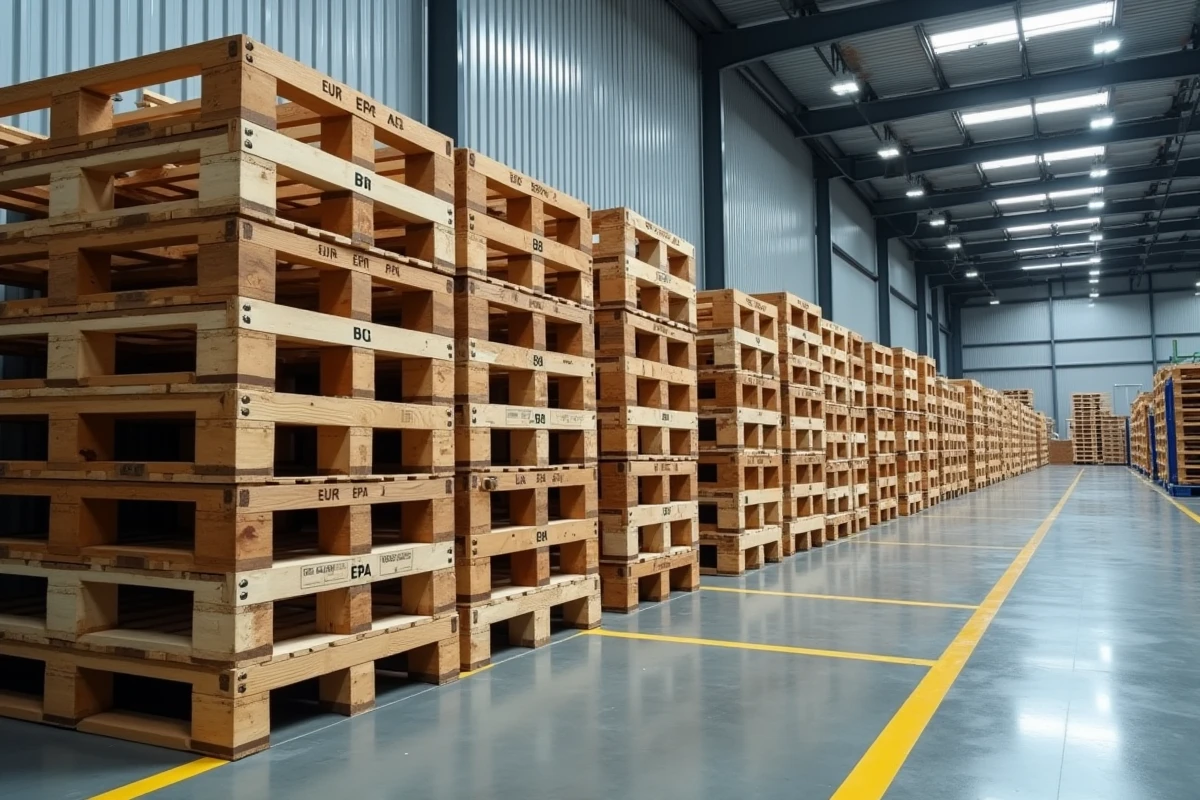
On-site constraints: how EPAL dimensions dictate warehouse organization
You cannot design a warehouse without knowing the pallet format that will circulate there. The EPAL pallet (800 x 1,200 mm) imposes specific aisle widths, beam heights, and rack depths. A deviation of a few centimeters in pallet tolerance can prevent insertion by a forklift or create a dangerous gap in the shelving.
Aisle width and type of truck
With a European pallet positioned sideways (1,200 mm side facing the aisle), at least 2.5 meters of aisle width is needed for a standard front truck. Switching to a reach truck reduces this width, but the investment is heavier. The pallet format directly determines the usable area / circulation area ratio in the warehouse.
Stacking and load resistance
The wooden European pallet supports a static load significantly higher than its dynamic load. In stacking (pallets piled on top of each other), the stress is on the corner blocks and the cross beams. Exceeding the allowed load, or using pallets with slightly non-standard dimensions, causes sagging that jeopardizes the stability of the entire stack.
- Always check the condition of the bottom boards and top boards before stacking, especially on pallets reused multiple times
- Adjust the number of storage levels to the actual weight of the loads, not just the theoretical weight of the pallet
- Prefer standardized extensions if the goods exceed the height of the platform, rather than excessive stretch film that hides defects
Wood, plastic, or aluminum pallets: the material changes dimensional constraints
The 800 x 1,200 mm format also exists in plastic and aluminum. The outer dimensions are identical to ensure compatibility with standard handling equipment, but tolerances and load behavior differ.
A plastic pallet maintains its dimensions over time. It does not swell with humidity, does not crack, and remains washable, which explains its adoption in the food and pharmaceutical industries. In return, its purchase cost is significantly higher than that of wood.
The wooden pallet remains the least expensive per unit, but it is also the one most often discarded after a few rotations. This paradox fuels discussions about circularity in logistics: you pay less at purchase, but replace more often.
Aluminum, rarer, is found in temperature-controlled environments (cold rooms, clean rooms). Its dimensions comply with European standards, but its empty weight and price reserve it for very specific flows.

European, American, or Asian standards: why the 800 x 1,200 format is not sufficient everywhere
The European pallet is a regional standard, not a global one. Intercontinental flows require dealing with other formats. The North American pallet (1,016 x 1,219 mm, or 40 x 48 inches) does not fit into the same racks or trucks.
In Asia, dimensions vary by country and sector. An export logistics flow that ignores these dimensional discrepancies loses usable volume in containers or imposes costly repackaging at the port of arrival.
- For exports to North America, check if the recipient accepts the EUR format or requires the GMA (Grocery Manufacturers Association) format
- For intra-European flows, the EPAL pallet remains the default choice, recognized and accepted in all member countries
- For shipments to Asia, consult the freight forwarder about accepted local formats to avoid repalletizing upon arrival
Responses vary on this point, as some Asian warehouses accept the EUR format without difficulty while others exclude it. Anticipating this issue at the time of the transport quote avoids late-discovered additional costs.
The pallet format is not an administrative detail. It is a parameter that structures storage space, conditions the choice of handling equipment, and influences transport costs at each rotation. Choosing the right pallet means sizing your entire logistics chain, from the first square meter of warehouse to the last kilometer of delivery.