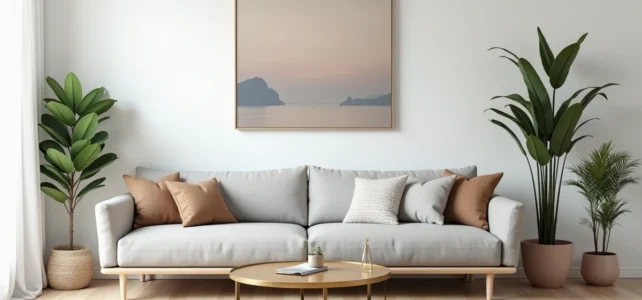
When replacing an old convector with a connected inertia radiator, you are not only changing thermal comfort: you are altering the visual reading of the room. A slim device, placed low, with app control, transforms an entire wall. It is through this type of concrete detail that housing trends take shape, long before the choice of a paint color.
Raw materials and reuse: low-carbon decor that changes an interior
There is a lot of talk about energy renovation, but the most visible trend in recent interiors is the exposed bio-sourced material as a decorative element. A cork panel placed at the back of a bookshelf, an uncoated hemp-lime partition, exposed solid wood beams on the ceiling: these technical choices become aesthetic choices.
Reuse follows the same logic. Recovering old cement tiles for a backsplash, reusing demolition bricks as cladding in a living room, or integrating an old oak floor into a new bedroom produces a result that new industrial materials cannot replicate. The patina and irregularities create a style that some magazines refer to as “happy sobriety,” directly linked to current cost constraints and environmental concerns.
The practical advantage of these natural materials (cork, hemp, raw wood): they contribute to the hygrometric regulation of the room. You improve the indoor atmosphere without an additional finish layer. Less paint, less glue, fewer VOCs in the air.
Several home decor trends converge towards this idea: you can follow the articles on the Salon Tendances Habitat website to see how these materials integrate into real projects, from floor to ceiling.

Colors and patterns: what concrete choices for a current style
The first reflex when wanting to modernize a space is often color. The palettes that work right now move away from the all-white Scandinavian look and the omnipresent gray of previous years.
Earthy tones and colorful accents
Terracotta, olive green, yellow ochre, clay brown: these colors are applied flat on an accent wall, not on all four walls. The idea is to create a focal point in the room without darkening the space. You paint one wall in the bedroom or the back of a niche in the living room, while the rest remains neutral.
For patterns, wide stripes are making a comeback on textiles (cushions, curtains), while botanical patterned wallpapers work well in small spaces like an entryway or hallway.
Combining colors and raw materials
A reused brick wall does not need color. A hemp-lime plaster doesn’t either. Mixing raw surfaces and flat colors avoids the showroom effect and gives a lively interior. Specifically, you keep natural materials on one or two walls and apply the chosen color opposite or in return.
Feedback varies on this point: some find that exposed cork does not age well in humid rooms. In a bathroom, it is better to reserve cork for the floor (treated) and opt for sober tiling on the walls.
Integrated home automation from the design stage: an underestimated lever of modernity
New constructions now integrate home automation pre-equipment (ducts, network sockets, preparation for shutters and connected heating) right from the structural work. It is no longer an afterthought; it is a standard.
In renovation, the constraint is different. Work is often done wirelessly, with modules to install on existing systems. The priority points to address are:
- Connected lighting, which allows you to modify the ambiance of a room without changing the fixture (color temperature, intensity, programmed scenarios)
- Heating control room by room, which reduces consumption while eliminating unsightly wall thermostats
- Motorized roller shutters, whose centralized control simplifies daily life and contributes to insulation in both summer and winter
Connectivity becomes a style element just like volumes or finishes. A stylish connected switch placed on a raw plaster wall contributes to visual coherence. The white plastic boxes from the 2000s are disappearing in favor of glass, brushed metal, or ceramic plates.
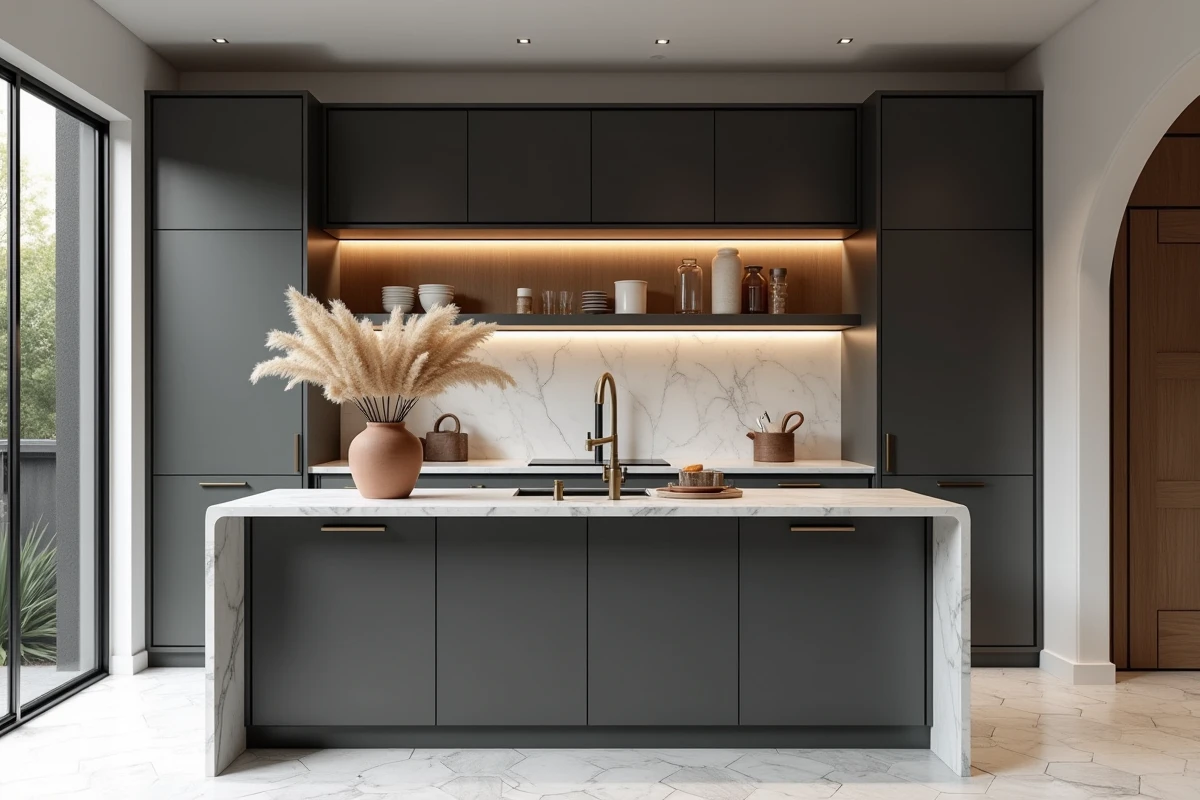
Living space layout: movable partitions and dual-purpose rooms
The underlying trend is reversibility. No longer do we break down a load-bearing wall to create a large open space. We install a sliding glass partition between the kitchen and living room, or a slatted wooden screen between the entry and the living area.
This choice has a direct practical advantage: you adapt the space according to the time of day. In the evening, you close the partition to isolate the noise from the kitchen. During the day, you open it to gain natural light.
Bedrooms are also evolving. An integrated office in the master bedroom (foldable wall shelf, shelf above) replaces the dedicated telecommuting room. In small spaces, a foldable bed with integrated storage frees up several square meters during the day.
- Movable glass partition like a workshop: separates without visually closing off, lets light through
- Wood or metal screen: delineates a space without closing it off, works well in an entryway or as a kitchen/living room separator
- Multifunctional furniture: benches with storage, extendable tables, consoles that convert into desks
The idea is not to transform everything but to choose one or two layouts that truly change the daily use of the room. A successful interior decoration project starts from the constraint of space, not from a magazine image.
What distinguishes stylishly renovated interiors from those that look dated after two years is rarely the budget. It is the coherence between the chosen materials, the applied colors, and how the space serves daily life. A wall with hemp plaster, well-controlled lighting, and a well-placed glass partition transform a living space more sustainably than trendy furniture replaced with the next season.