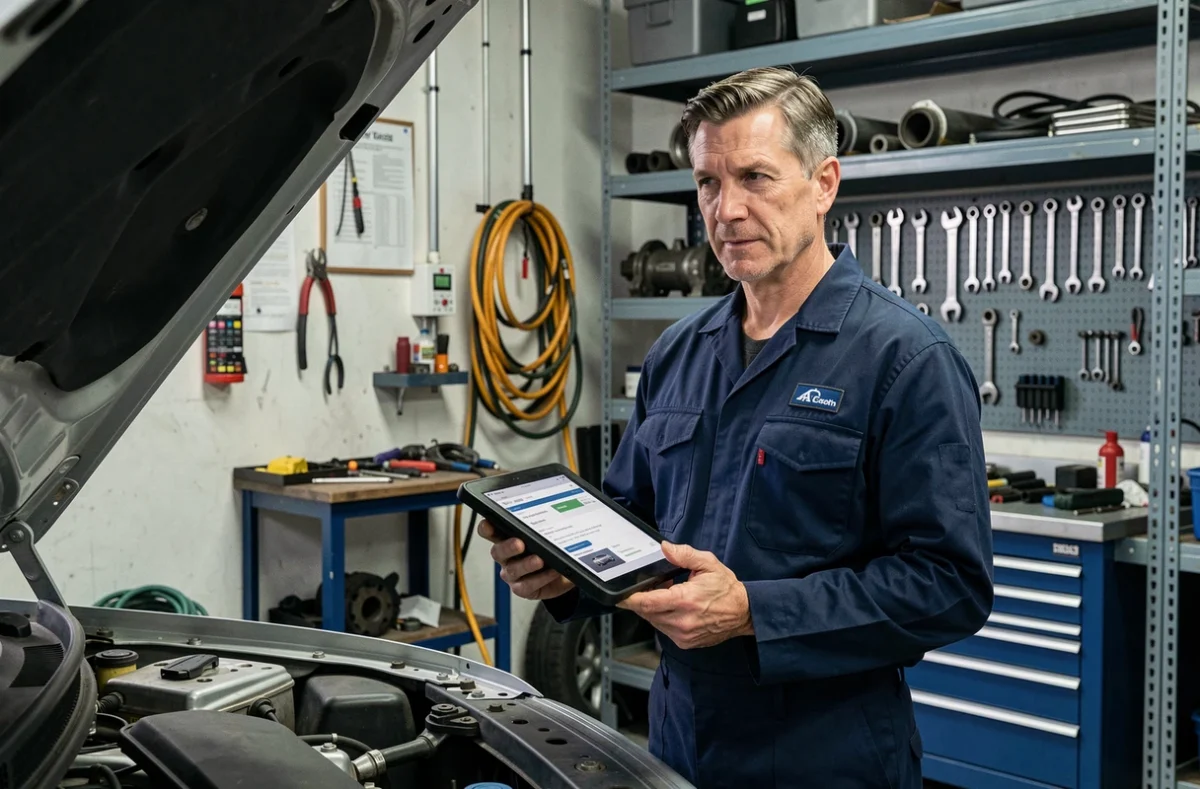
A vehicle used for business purposes generates two types of outgoings: day-to-day expenses (fuel, maintenance, insurance) and reporting obligations that determine how those expenses are treated for tax purposes. Managing both aspects effectively helps reduce the vehicle’s true cost without risking a tax reassessment.
Business vehicle downtime: the hidden cost
Most guides to vehicle management focus on visible costs: fuel, tax and financing. Yet one factor that is rarely quantified can affect the profitability of a business vehicle: the number of days it is unavailable.
Every day a vehicle is off the road for servicing, repairs or a roadworthiness test represents lost business for professionals who rely on travel. Planning ahead for these periods can make a real difference.
Scheduling maintenance outside peak periods, negotiating a replacement vehicle as part of the maintenance contract, or finding a nearby short-term rental provider are all ways to limit the impact. By bringing together professional and tax advice on vehicles tailored to your situation, you can build a management framework that accounts for this often-overlooked factor.

Actual expenses or the mileage allowance: choosing the right deduction method
The choice between actual expenses and the mileage allowance determines the tax deduction available for your vehicle. The two methods suit different usage profiles.
The mileage allowance and what it covers
Published annually by the tax authorities, the mileage allowance sets a flat rate for each kilometre travelled for business purposes. It covers vehicle depreciation, insurance, routine maintenance and fuel. In practice, a single calculation replaces the need to keep every receipt.
This method suits professionals with moderate maintenance costs who prefer simpler administration. The vehicle’s tax horsepower and annual mileage are the two variables used in the calculation.
Actual expenses: when itemised deductions are more advantageous
The actual-expenses method lets you deduct every expense incurred: oil changes, tyres, repairs, fuel and business parking. This option requires you to keep all supporting documents and maintain detailed records.
It can be more advantageous in several specific situations:
- The vehicle has low tax horsepower but incurs high maintenance costs (high mileage or demanding driving conditions)
- Major repairs were carried out during the year, pushing costs above the flat-rate mileage allowance
- The professional uses a commercial vehicle whose specific costs (modifications, accelerated wear) are not adequately reflected by the allowance
Comparing the two amounts each year before filing your tax return helps you consistently choose the more favourable option. You are not required to make the same choice from one year to the next.
VAT recovery on a business vehicle: the rules in practice
VAT recovery on vehicle expenses is subject to strict rules that vary by vehicle category. Confusing a passenger car with a commercial vehicle can be costly.
VAT on the purchase of a passenger car cannot be reclaimed, regardless of the proportion of business use. The same rule applies to petrol used by this type of vehicle, although partial VAT recovery is allowed on fuel.
For commercial vehicles, however, VAT on the purchase, maintenance and fuel (diesel or electricity) can be reclaimed in full, provided the vehicle is used exclusively for business purposes.
Three points deserve particular attention:
- So-called “VP-derived” vehicles (passenger cars with the rear seat removed and approved as commercial vehicles) qualify for VAT recovery, provided the registration document lists the vehicle category as CTTE
- VAT on maintenance services (servicing, parts replacement) for a commercial vehicle can be reclaimed in full, subject to supporting invoices
- Mixed personal and business use complicates VAT recovery: the tax authorities may challenge the deduction if the commercial vehicle is also used for private journeys

Low-emission zones and restrictions on company vehicles
Low-emission mobility zones (ZFE-m) impose driving restrictions that directly affect the day-to-day management of a business fleet. A vehicle with a Crit’Air 3 rating or higher may be barred from certain metropolitan areas during business hours.
For companies whose work involves regular urban travel, this is more than an environmental issue. It affects which vehicle is assigned to each job. Assigning an older vehicle to rural journeys and reserving newer vehicles for urban areas is a practical way to allocate the fleet when replacing all vehicles is not an option.
Checking the implementation schedules for each city or region on your route is an essential step before planning any journey. These schedules change, and penalties for non-compliance may include repeated fines.
Permanent vehicle or occasional solution: choose based on the job
Assigning a permanent vehicle to every employee is not always the most cost-effective option. For occasional travel, comparing the cost of a company vehicle with mileage reimbursements for using a personal vehicle—or with a one-off rental—can reveal significant differences.
Business car-sharing, which involves sharing a small fleet among several users through a booking system, can in some cases reduce fleet size without disrupting operations. This model works best when journeys do not take place at the same time.
The right decision depends on tracking actual usage: how often employees travel, the mileage for each job and the number of days each vehicle is actually used. Without this data, any decision about fleet size is only an estimate. A shared spreadsheet or dedicated fleet management tool is enough to collect this information over a few months before making a decision.